
The Croissant Incident
A quiet morning in Collioure, a stolen croissant, and the unsettling reminder that humans have changed more than just the landscape.

Dear Life Traveler,
We are back with a travel story, a postcard through words.
I recommend you sit back and take a quiet moment, and then let yourself be immersed in a not-so-quiet one in Collioure, a small port town on the coast of France.
If you want to accompany the reading with music, for today’s story, I picked “Experience” by Ludovico Einaudi.
Enjoy.
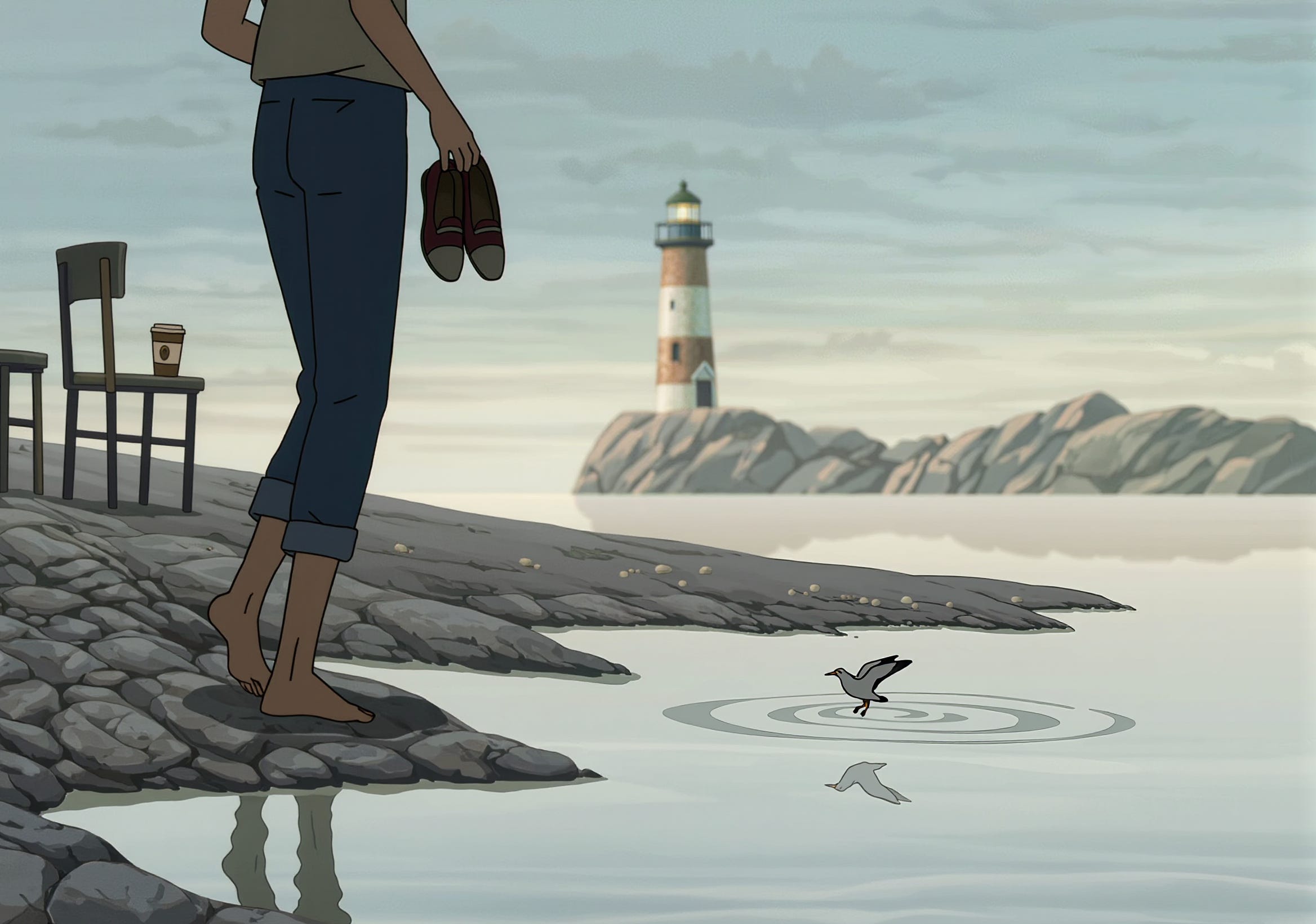
If you’ve never seen a half-moon-shaped neck, maybe it’s for the best. And for those of you who have, no wonder humans will be the end of the animal kingdom.
End of spring holds my favorite mornings. It’s still cold enough that dew covers patches of grass, but warm enough for clear skies and jacketless walks. The stone sidewalk pebbles sound hollow under my blue, velvety veneziane. The air is crisp, and so are the sounds, with not enough people around to absorb the echo.
Collioure is a small, charming port town right after the Spanish Costa Brava, the first stop in France along the drive, nestled in an awe-inspiring stretch of coast that has enchanted painters, artists, and romantics for years. Bushes of bright fuchsia bougainvillea stand as a testament to that, like the one Ambuj and I sat under last night outside a little wine shop, eating cheese and drinking wine.
This morning I woke up early, and while he indulged in sweet morning sleep, I stepped out with my notebook in hand, searching for a quiet coffee shop where I could write and have a good cappuccino. Aimless steps lead me to a small café with tables facing a tiny pebble beach in front of the lighthouse. I’m the first customer, which means I get to choose one of the tables closest to the water.
Sea and sky are gray, the sun too low to show hints of blue, and the surface perfectly flat, a clean canvas reflecting the lighthouse a few meters from the shore. Perched on the railings, a couple of seagulls track the water with hungry focus, and a woman in a bright green swimming cap and a one-piece swimsuit slips in, breaking the stillness and sending ripples around her body. A few strong strokes, and she’s gone.
The water looks cold, the temperature almost emanating from the gray hue, but most likely not as cold as the Pacific. A sudden need to dip my feet in the cold liquid wakes my senses, but, as I usually do, I talk myself out of that small joy. Where would I leave my bag? I just sat down, it’s rude to walk away, I need to be proper. And so, with an early-rising sense of sadness, I get lost thinking about the cold embrace of ocean water, the floating sensation, the slow surrender I feel when I swim in the Berkeley Marina, and the flavor of salty water on my lips.


“Mademoiselle, qu’est-ce que vous voulez pour le petit-déjeuner ?”
The waiter startles me, catching me by surprise and pulling me back to the present. We’re in France. I’m at a coffee shop. All I manage is to blink a couple of times while a thick blanket of void coats my brain. My eyes land on him, a middle-aged man who does not match the cuteness of the landscape. Pity. Where are the cute French men Paris promises? He stares at me, patient but expectant, and after a couple more blinks, when I finally come back to my senses, I decide he must be asking about breakfast.
“Un cappuccino,” I say, in the best French accent I can manage.
“Sure,” he replies.
So much for the effort of remembering a word of French. I keep my disappointed face neutral and turn back toward the water, the swimmer still lost beyond my view.
“A full breakfast special,” two foreigners order loudly in broken English, pulling my gaze away from the sea. I pretend not to be annoyed that I’m not alone anymore, and that they picked the table next to mine, but I can’t really blame them. The view is so sweet.
A few minutes pass, and I move my focus to the thin-lined pages of the diary and my blue pen, words about the duality of being a complex human, wanting to be different than what society asks me to be, flooding onto the paper. I barely notice when my cappuccino arrives, along with the “breakfast special” at the other table. It’s the smell of omelettes that pulls my gaze from the page to the table next door, where a feast of breakfast items sits in front of my neighbors’ satisfied smiles.
The woman is in her seventies, with plump red cheeks and shoulder-length white hair, wearing a touristy wide-brimmed hat I saw yesterday in one of the local shops. She is wearing a thin cotton shirt with big blue flowers, her chest carrying a faint red of sunburn, and I wonder if she put on sunscreen this morning. The man across from her wears a matching floral cotton shirt, thin sporty glasses with a strap crowning his head. He takes the first sip of his drink, a latte, judging by the amount of milk in the transparent glass. They sit in silence, peacefully nibbling at their food.
A smile pulls at my lips. There’s usually an unspoken agreement between early risers, both wanting a slow moment to wake the senses, the body, the mind. I go back to my pages, now moving to explore how Leo and Virgo energies can work together, based on my natal chart.
“Aahhh.” A squeal makes me leap.
My head snaps toward the scream, my brain immediately scanning for danger, my legs almost lifting me out of the chair. The woman at the table next to mine almost falls backward, grabbing the table at the last second, knocking over a glass of orange juice and losing her hat in the process. Her husband hops back, still holding his chair, and starts mumbling in a tone that sounds like curses in his native language.
And I’m just in time to see a healthy, big seagull proudly standing on the couple’s table, an apricot-filled croissant from the breakfast special clamped in his beak. His defiant stare makes the dark apricot jam shine where his beak grips the croissant, looking at us with a proud stance.
“Sho, sho!” The not-cute waiter shouts loudly, running toward us. The seagull couldn’t care less, now stepping through the orange juice with his webbed feet and splashing it everywhere, then bending and taking flight, landing not far from us on the beach.
I can’t help it. I turn my head a little and smile, trying to hold off a laugh, pretending I didn’t see. I notice the husband is subtly laughing too, done with his curses, watching his wife in distress without helping much. It somehow makes it worse, while the poor woman frantically tries to get her life back together.
He grabs the hat. She fishes the sunglasses out of the orange juice. The waiter offers paper napkins, and I can almost hear him adding, in French, “I’ll get you another one immediately,” not that they would understand.
I turn my head back toward the water, grinning, trying to look innocent. A sip of cappuccino is a welcomed disguise.
The seagull is now on the pebble beach, staring at the scene with the giant croissant still lodged in his beak, absolutely unapologetic, like he did this a thousand times and will do it again. His morning routine. A quick bend of the neck and he tosses it into the air like it’s a fish.
Except it isn’t a fish.
I watch it slide down his throat until it stops, pastry not as slick as fish skin. It leaves a noticeable lump in his neck, a half moon under feathers. He makes a couple of harsh, choking noises, and all of a sudden the scene isn’t fun anymore.
But then he lifts his wings, steps into the edge of the ocean, and scoops water into his beak. One swallow, then another.
The lump disappears, and so does he, flying toward the horizon.
And I just stand there. The water is calm once more, the couple is sitting again, a new “breakfast special” makes it to their table, and silence covers the scene. I grab my cappuccino and everything looks the same as before, like nothing happened, the only signs of disruption my hidden grin and my drink gone cold.
But everything has changed.
A seagull could die from apricot jam, a sweet death indeed, another confirmation that we, humans, have twisted nature yet again.
Survival is not supposed to look like this. It’s supposed to be hunger, skill, effort, adaptation. Instead it’s sugar and convenience and crumbs, a shortcut engineered by us, and not how species are meant to survive for thousands of years.
And that’s the part that gets under my skin. We, humans, have changed nature permanently, and while environmental damage is obvious, we’ve also changed our internal nature too. We say we want safety, comfort, stability, and sometimes we do, sometimes we need it, but how often does it come with a quiet trade? A small betrayal, where you choose what’s easy over what’s true, what’s familiar over what’s alive. And we might be dimming ourselves in the same way, little by little, until we forget what our instincts sounded like.
And as I feel saddened for the seagull, I realize I feel a bit sad for us too, for the chasm between us, our nature as animals, and nature itself.
I open my diary again, but the page feels different, heavier. I close it and place it back in my backpack, with the pen. I gulp the last bit of cappuccino and head toward the water, taking off my shoes to do what I’ve wanted to do since the moment I arrived here.
I let the cold take me.
From the shore,
Simona
P.S. If you liked this story, hit subscribe, leave a comment, restack, or share it with a friend. That’s how more life travelers find their way here. 🫶🏼
Do you like travel stories? Check this one out: a scary night from my Mongol Rally adventure. We were four girls driving from Italy to Mongolia in a Fiat Panda.
The Mystery of Karakanda

I jolted awake inside our faithful Bertoni tent, anchored firmly to the soil of a remote Mongolian hillside.
Bellissimo 💖
This was such a delightful story. It had me laughing, it kept me reading, it had me gasping for air at moments along side your characters. Can’t wait to hear your next adventure!